Thangka Paintings
A thousand-year-old sacred tradition painted one brushstroke at a time. The reason I founded the Thangka Collective is to make sure it survives.
Some moments rewrite you quietly, without announcement. Mine came inside a monastery in Gangtok, Sikkim, where a young monk sat cross-legged on a wooden floor, a fine squirrel-hair brush in his hand, painting a deity so intricate it made me hold my breath. I had seen Thangkas in books and museums. I had never seen one being born.
That afternoon changed everything. It sent me across the mountains to Bhutan, deeper into the tradition, and ultimately back home with one clear conviction: this art form cannot be allowed to quietly perish. That conviction became the Thangka Collective. But before we get to that, let me take you to the beginning, because Thangka painting is one of humanity’s most extraordinary stories.
What Is a Thangka? A Complete Introduction to Himalayan Scroll Painting
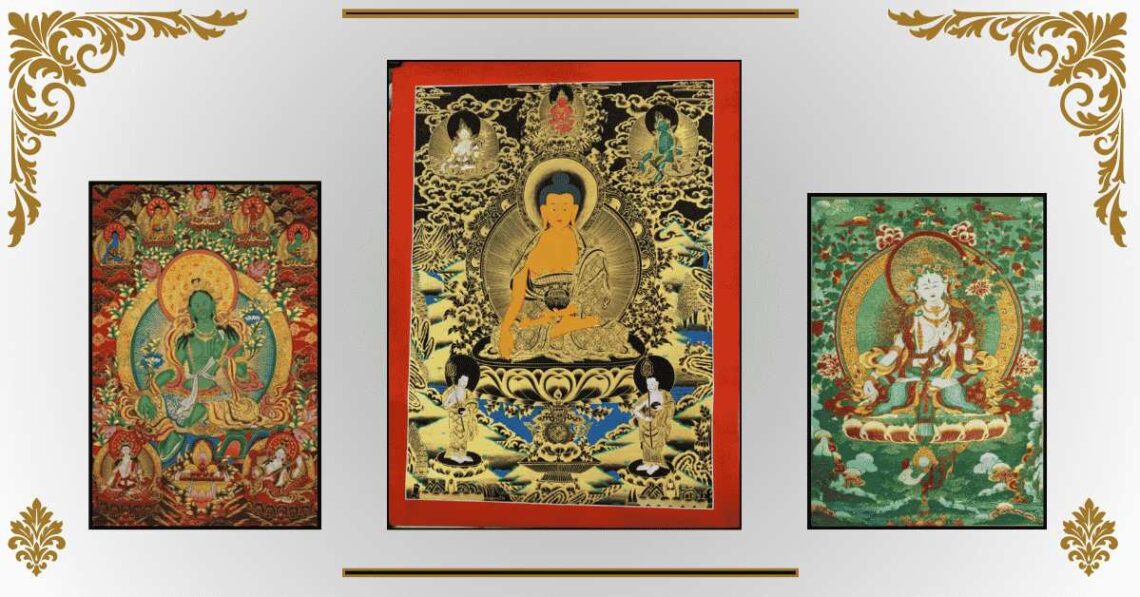
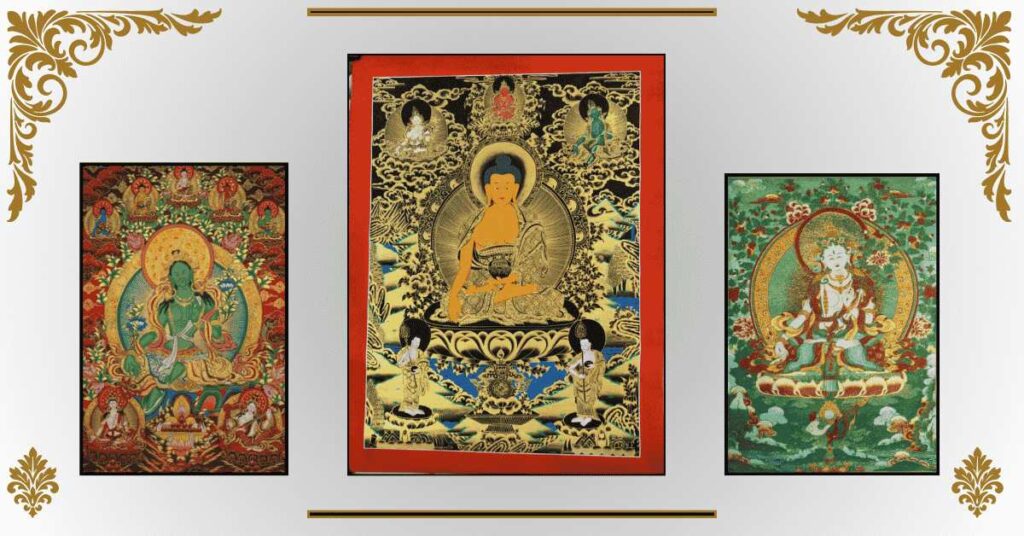
The word Thangka (also spelled Tangka or Thanka) derives from the Tibetan words meaning “recorded message” or “thing one unrolls.” At its simplest, a Thangka is a painted or embroidered Buddhist scroll — typically on primed cotton or silk — depicting deities, mandalas, cosmological diagrams, or narrative scenes from the life of the Buddha and great masters. But to call it simply a “painting” is to miss the point almost entirely.
A Thangka is a portable sacred space. It can be rolled up and carried across mountain passes on the back of a pilgrim. It can be unfurled inside a nomad’s tent to create an instant shrine. It is altar, temple, and scripture all at once — a convergence of visual art, devotional practice, and philosophical teaching in a single cloth.
The Origins of Thangka Art: A History Stretching Back 1,000 Years
How Thangka Painting First Emerged in Tibet
The story of Thangka begins with the great Buddhist transmission into Tibet. As the Dharma moved northward from India in the 7th and 8th centuries under the patronage of King Songtsen Gampo and later Guru Padmasambhava, it needed a visual language — a way to convey complex tantric cosmologies to a population that was largely nomadic and non-literate. Sacred images had to travel. They had to survive altitude, cold, and constant movement. Manuscript illumination was too delicate. The scroll painting on cloth — portable, durable, sacred — was the answer.
By the 11th century, distinct regional styles had crystallised. The Western Tibetan style drew heavily from Indian Pala Buddhist art. The Central Tibetan style developed under Chinese influence during the Yuan and Ming dynasties. The Newari tradition of the Kathmandu Valley — considered by many scholars to be the most technically refined — contributed the precise geometric frameworks still used today. Each tradition was governed not by artistic whim but by sacred texts called sadhanas, which prescribed exactly how each deity must look: the angle of the eyes, the number of arms, the colour of each garment, the position of the fingers.
The Sacred Geometry Behind Every Thangka
What strikes the uninitiated first is the incredible precision. A Thangka artist does not improvise. Before the first brushstroke of pigment falls, the entire composition is mapped using a system of geometric grids (thig-tse) that have remained largely unchanged for centuries. The proportions of the central deity’s body, the placement of secondary figures, the relationship between foreground and mandala background — all are determined by canonical measurement. To deviate is not artistic licence; it is considered spiritually incorrect.
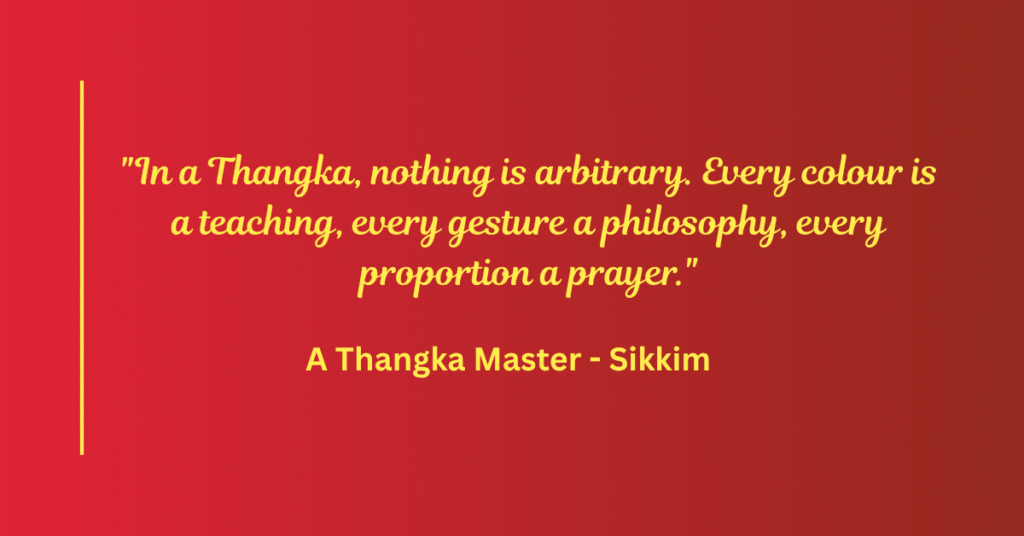
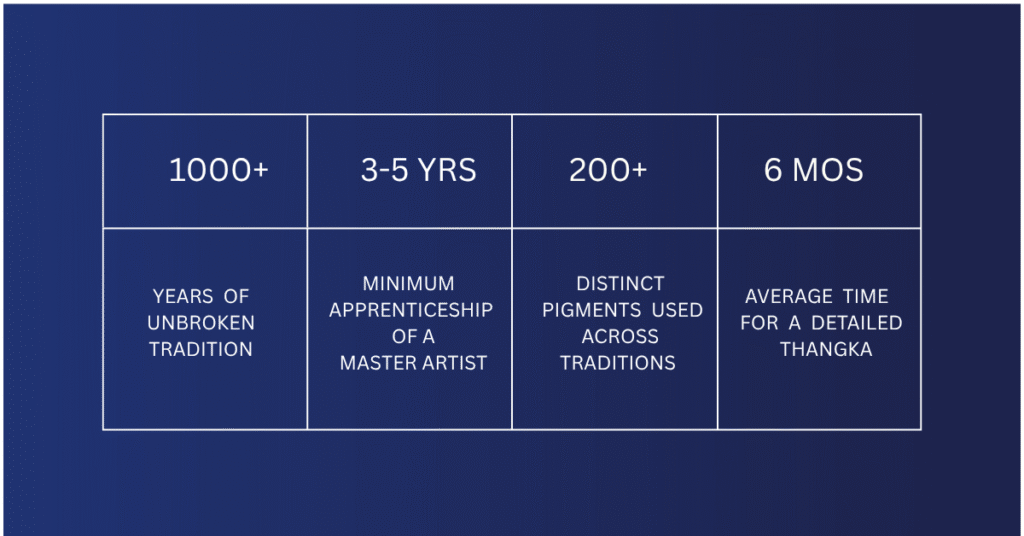
This is why Thangka training takes years, sometimes a lifetime. A student first learns to draw the geometric grid with precision. Then, the proportions of the human figure in the Buddhist canon. Then, individual deities, one at a time, in strict sequence. Only a master, someone who has internalized the tradition deeply enough, is trusted to paint the eyes, the act that ritually “opens” the deity and transforms paint on cloth into a living sacred object.
The Spiritual Significance of Thangka Paintings in Buddhist Life
Thangka as a Meditational Tool, Not Just Decoration
To understand why Thangkas matter so profoundly in Himalayan Buddhism, you must understand how they are used. A practitioner does not hang a Thangka on a wall to admire it. They sit before it. They meditate on it. In Vajrayana Buddhist practice, the deity depicted in a Thangka is visualised internally — the image becomes a map of consciousness, a guide into one’s own mind. The external painting and the internal visualisation mirror each other until, ideally, the boundary between them dissolves.
In monastery life, Thangkas are used by teachers to explain complex doctrines, the Wheel of Life (Bhavacakra) Thangka, for instance, is essentially an illustrated cosmological textbook, depicting the six realms of existence, the twelve links of dependent origination, and the poisons of the mind, all in a single image. Elsewhere, large ceremonial Thangkas, some several stories tall, are unfurled during festivals like Losar (Tibetan New Year) and Tsechu in Bhutan, where the mere sight of the image is considered to confer blessings on those present.
Commissioning a Thangka as an Act of Merit
In Himalayan Buddhist societies, commissioning a Thangka has traditionally been one of the highest acts of religious generosity a layperson could perform. Families commissioned them to mark births, deaths, marriages, and illnesses. They were offered to monasteries as donations. They were created to accumulate merit for the deceased. The entire economy of Thangka production was woven into the fabric of religious life, the artist, the patron, and the deity forming a triangle of mutual purpose.
Thangka as Livelihood: The Artists Behind the Sacred Scrolls
For generations across the Himalayan belt — in Boudhanath, Kathmandu; in Patan; in Thimphu and Paro; in Gangtok and Leh — Thangka painting has been a hereditary profession, passed from father to son and, increasingly today, mother to daughter. Entire communities have organised their economic lives around this art form. The Newar community of Nepal, in particular, developed distinct artisan castes whose identity, status, and livelihood were inseparable from Thangka and Buddhist ritual object production
The economics are unforgiving even in good times. A single, high-quality Thangka on natural mineral pigments with gold detailing can take six months to a year to complete. The cost of materials like lapis lazuli, malachite, cinnabar, and gold leaf is significant. The return, sold through monasteries or export dealers, rarely reflects the true labour. For many artists, Thangka painting is both calling and sacrifice.
The Threats Facing Thangka Painting Today — and Why This Matters Urgently
Mass Production and the Erosion of Authentic Craft
The most visible and immediate threat to authentic Thangka art is the flood of commercially mass-produced imitations that have swamped tourist markets across Nepal, India, and the broader diaspora. These are typically machine-printed or assembly-line painted with synthetic pigments, made to a price point and a tourist timeline. They look, superficially, like Thangkas. They are not. They carry none of the canonical precision, the sacred intention, the mineral richness, or the meditative depth of an authentic work. And yet they are what most people encounter and purchase — undermining both the economic viability and the cultural standing of genuine artists.
The Disappearance of Master Artists and Apprentices
The second threat is quieter and perhaps more devastating: the declining transmission of mastery. As younger generations in Himalayan towns are pulled toward urban economies, digital careers, and migration, the pool of students willing to undergo the years of rigorous, low-paid apprenticeship required to truly learn Thangka painting is shrinking. Several regional sub-traditions, particular styles from Dolpo, from certain lineages in eastern Tibet, and from smaller monastic centers have already lost their last living masters. When that happens, no book can fully recover what was lost. Sacred art traditions are oral and gestural; they live in the hands, not on pages.
Political and Geographic Displacement
The displacement of Tibetan communities since the mid-20th century ruptured the primary lineage of Thangka transmission. While exile communities in India and Nepal have preserved much and in some ways revived the tradition, the dislocation severed many master-apprentice relationships and scattered communities whose knowledge was inseparable from place. Bhutan, uniquely, offers one of the world’s last environments where Thangka production remains organically embedded in a functioning Buddhist state, which is precisely why my time there felt so extraordinary.

My Journey to Sikkim and Bhutan: What Thangkas Did to Me
I went to Sikkim as an answer to my soul, which craves to look at the mountains time and again, and was wholly unprepared for what I would find. At the Rumtek Monastery, I stood before a wall of ancient thangkas and felt something I can only describe as recognition, not of the images themselves, but of the quality of attention they demanded. These were not things to be glanced at. They required stillness. They gave back in exact proportion to what you brought.
In Bhutan, the experience deepened. At the National Institute for Zorig Chusum in Thimphu, the school of traditional Bhutanese arts, I watched students as young as fourteen bent over wooden boards, learning to draw the proportional grid of a deity with the same instruments their teachers’ teachers had used. There was no romance to it. It was rigorous, repetitive, humble work. And from it, slowly, the divine took shape in paint and cloth.
I bought three Thangkas on that trip from Sikkim. But I came home carrying something more, a question I could not put down. How does this survive contact with the 21st century? Who is building the bridge between these artists and the global audience of people who would genuinely treasure and support this work, if only they could reach it?
I found no satisfactory answer. So I decided to try to be one.
The Thangka Collective: Bringing Sacred Art to Those Who Will Honour It
The Thangka Collective was founded on a simple premise: authentic Thangka artists deserve a direct relationship with the people who value their work. Not mediated by tourist markets, not undercut by mass production, not filtered through layers of intermediaries who see these objects as inventory rather than sacred creations. We work directly with verified master artists and their apprentices across Nepal, Bhutan, Sikkim, and Ladakh, ensuring provenance, fair compensation, and proper cultural context for every piece we represent.
We believe that every authentic Thangka purchased is a vote for the tradition’s survival. Every person who understands what they are looking at becomes, in a small but real way, a patron of something that took humanity a thousand years to build — and could be gone within a generation if we look away now.
This is not a rescue mission driven by sentiment. It is an act of recognition: that beauty of this depth, this intentionality, this spiritual precision, has a place in the contemporary world — and that the artists who carry this knowledge forward deserve to be sustained by it.
Come find the painting that finds you. Every brushstroke in our collection was made by a hand that has spent years learning to make the divine visible. That hand deserves to keep painting.
© 2026 The Thangka Collective. Honouring a thousand-year tradition, one painting at a time.